A Deduction
Reduces the income used to calculate your tax. A $1,000 deduction does not automatically save $1,000 in tax.
Think: less income subject to tax. THE TAX CUTTERY®
Tax Preparation · Tax Planning · Tax Resolution
A Professional Reference From THE TAX CUTTERY®
Identify The Credit. Understand The Question.
A credit named on a return. An IRS letter. A question about a dependent, tuition or adoption expenses. Choose the subject below for a clear explanation of what it addresses, which records matter and where it fits in the broader tax picture.
No purchase is required to start the free initial tax consultation. Professional services are separately scoped.
2026 Tax Year · Returns Generally Filed In 2027Browse By Credit · A–Z
Choose the name or abbreviation you recognize. Each entry covers its purpose, common questions, relevant records and official IRS references.
Start Here
Reduces the income used to calculate your tax. A $1,000 deduction does not automatically save $1,000 in tax.
Think: less income subject to tax.Reduces the tax, generally down to zero. An unused amount does not automatically become a refund; some credits have separate carryforward rules.
Think: reduce tax within the credit’s limits.Can produce a refund after the tax reaches zero. A partly refundable credit has separate limits on how much can come back to you.
Think: eligibility first, calculation second.Illustration only: if the relevant tax before a credit is $600, an allowed $1,000 fully refundable credit could reduce it to zero and leave $400 refundable. A $1,000 nonrefundable credit could reduce that tax to zero without creating the extra $400. Actual returns apply ordering rules, limits and other payments.
Work & Household Income · Refundable
Working hard is one fact. Knowing which income counts is another.
EITC can benefit eligible employees and self-employed workers, with or without qualifying children. Income, filing status, residency, identification numbers and the qualifying-child rules all matter. Interest and retirement income are not wages, and investment income has a separate limit.
For 2026, the maximum ranges from $664 without a qualifying child to $8,231 with three or more. Investment income must not exceed $12,200. These are limits, not a quote for your refund.
Keep Within Reach: W-2s, business income and expense records, investment statements, and the dates children lived with you.
Read The IRS Source ↗Children & Dependents · Partly Refundable
Same child. Different tests. A return needs the whole story.
The Child Tax Credit and its refundable Additional Child Tax Credit depend on more than a child’s name on the return. Age, relationship, residence, support, income and the required work-eligible Social Security numbers affect eligibility. Schedule 8812 calculates these benefits.
For 2026, the maximum Child Tax Credit is $2,200 per qualifying child; up to $1,700 may be refundable through ACTC. The refundable amount is part of the credit, not an extra $1,700 on top.
Keep Within Reach: Household changes, residency records, identification information through secure intake, support details and income records.
Read The IRS Source ↗Family Beyond The Under-17 Rule · Nonrefundable
A dependent can still matter after a birthday changes the rules.
An eligible older child or another qualifying dependent may fit the Credit for Other Dependents when the Child Tax Credit does not apply. Dependency and income tests still matter. An eligible dependent’s identification-number rules differ from the Child Tax Credit rules.
The maximum is $500 per eligible dependent, subject to income limitations. This credit reduces tax; it does not itself create a refund after that tax reaches zero.
Keep Within Reach: Dependency and support information, the dependent’s income, and citizenship or residency facts when relevant.
Read The IRS Source ↗College & Education · Partly Refundable
The tuition statement is the beginning of the calculation.
AOTC concerns eligible students in their first four years of higher education, subject to enrollment, prior-credit, income and other requirements. Scholarships and education-account withdrawals have to be coordinated with the expenses. The Lifetime Learning Credit is a different, nonrefundable education benefit.
AOTC can be up to $2,500 per eligible student; up to 40%, capped at $1,000, may be refundable. Special rules can deny the refundable portion to some younger taxpayers. For 2026, new work-eligible SSN requirements apply to education credits.
Keep Within Reach: Form 1098-T, tuition account details, required course-material receipts, scholarships, 529 distributions and prior years of AOTC claims.
Read The IRS Source ↗Growing Your Family · Partly Refundable
A major family milestone deserves careful tax coordination.
Qualified adoption expenses, when the adoption becomes final, domestic or foreign status, employer benefits and income limitations can change the result. Special-needs adoptions have specific rules. Expenses for adopting a spouse’s child do not qualify.
For 2026, the maximum credit is $17,670 per eligible child, with up to $5,120 potentially refundable. This is a per-child limitation, not a new allowance that resets every year for the same adoption.
Keep Within Reach: Legal and agency records, expense dates, finalization documents, employer reimbursements and any prior adoption-credit claims.
Read The IRS Source ↗Related, But Different
Paying the rent does not settle it. Filing status generally turns on whether you are unmarried or considered unmarried, whether you paid more than half the cost of keeping up the home, and whether you have a qualifying person. A qualifying dependent parent can sometimes live elsewhere.
A filing status can change tax rates and the standard deduction. It is not a refundable credit, and you do not select it simply because you earn the most in the home.
Check The IRS Filing-Status Rules ↗Everyday Situations · Illustrative Only
A child splits time between two homes. Count the actual nights and check the applicable rules. A 50/50 custody label does not automatically mean each parent can claim the same benefit. Form 8332 does not transfer EITC or Head of Household eligibility.
A student gets a tuition statement. Scholarships, education-account withdrawals and dependency can change the credit. Some young filers can claim only the nonrefundable portion of AOTC.
A worker starts a side business. Gross receipts and net earnings are different. Accurate income and expenses matter before calculating EITC.
Tell Us What Changed In Your Household →Good Questions Support A Better Return
A form can tell us a child’s name. It may not explain a separation, a move, a new household member, school attendance or who paid the household expenses. Those details can change the answer.
Paid preparers have specific due-diligence responsibilities for EITC, child and other dependent credits, AOTC and Head of Household. Asking questions, checking inconsistent information and retaining the required records are part of doing the job properly.
The free prerecorded consultation gives you room to explain the concerns behind the paperwork. Genesis continues the private organizer and document collection when applicable. Tell us what you know and identify the gaps; do not guess to fill a blank.
Why The IRS Requires These Questions ↗Use this as a starting checklist. The firm will identify what is relevant to your situation and what is already in your file.
No personal answers or documents are collected on this educational page. Use the private intake and upload process for tax identifiers, returns and supporting records.
The Year Matters
The figures marked 2026 refer to the 2026 tax year, generally filed in 2027. A 2025 return filed during 2026 still uses 2025 rules. An older IRS page or last year’s tuition-credit advice may not reflect a newer identification requirement.
The IRS has also published proposed rules and a draft Schedule 3-A concerning eligibility for refunded portions of certain credits. A proposal or draft is not a final filing instruction. Check the final applicable forms and guidance before filing.
Read The Proposed Rules ↗ · Check IRS Draft And Final-Form Status ↗Direct Answers
A refundable credit can produce a refund when the allowed credit exceeds your federal income tax. You still have to meet that credit’s eligibility rules and file the required return. Refundable does not mean everyone receives the maximum.
A deduction reduces the income on which tax is calculated. A credit reduces the tax itself. Whether an unused credit can produce a refund depends on whether that credit is refundable.
Possibly. EITC has a path for workers without a qualifying child, with its own income, age, residency and dependency requirements. Having no children does not automatically rule it out.
Possibly. Net earnings from self-employment can count as earned income. The business income and expenses must be reported correctly, and all other EITC requirements still apply. A 1099 total alone does not establish the credit.
No. Each benefit has its own tests for matters such as relationship, age, residence, support, income and identification numbers. Qualifying for one benefit does not establish eligibility for every other child-related benefit.
The same child cannot be used for EITC by two taxpayers for the same tax year. Where a child qualifies for more than one person, the applicable tiebreaker rules determine who can claim the child. A custody agreement by itself does not settle every federal tax benefit.
No. When the requirements are met, a custodial parent’s release can allow the other parent to claim certain dependent-related benefits. It does not transfer EITC or Head of Household eligibility. Different rules apply to different benefits.
No. The Credit for Other Dependents is nonrefundable. It may reduce federal income tax for an eligible dependent who does not qualify for the Child Tax Credit, but it does not itself create a refund after that tax reaches zero.
No. Head of Household is a filing status. Eligibility generally requires being unmarried or considered unmarried, paying more than half the cost of keeping up a home, and having a qualifying person. Special rules can apply, including for a dependent parent living elsewhere.
No. AOTC has student, expense, income, dependency and identification requirements. Additional age, support, parental-survival and joint-return rules can prevent a young taxpayer from claiming its refundable portion. Receiving Form 1098-T does not establish eligibility by itself.
For tax year 2026, the taxpayer or spouse on a joint return, and the student if a dependent, must have a Social Security number valid for employment issued before the return’s due date, including extensions. This requirement applies to both AOTC and the Lifetime Learning Credit.
No. The same expenses cannot be used for multiple tax benefits. Tax-free scholarships, employer assistance and tax-free education-account distributions can affect which expenses remain available for an education credit.
The same expense cannot support both an income exclusion for employer-provided adoption benefits and an adoption credit. Review the reimbursement, qualifying expenses, timing and income limitations together.
Living arrangements can affect EITC, dependent benefits and filing status. Dates and relationships matter. The organizer collects records; the consultation helps explain life changes and circumstances the forms alone may not show.
No purchase is required to start the free initial tax consultation. The Guide is optional for return preparation and required for Tax Advisory. Preparation, planning, representation and coaching are separately scoped services.
Keep the complete notice and its deadline. Bring it into the tax consultation so the firm can determine the appropriate next step. Reviewing this page or starting an intake does not extend an IRS response deadline or establish a representation engagement.
Make The Next Tax Question Less Of A Mystery
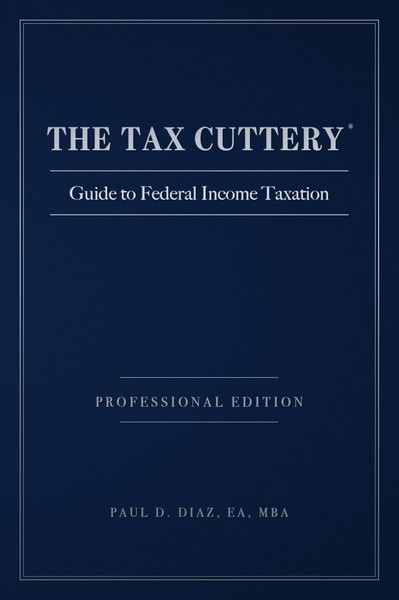
THE TAX CUTTERY® Guide to Federal Income Taxation, Professional Edition
Planning, preparation and resolution belong in the same conversation. The Guide connects all three, so you can understand more of the questions behind your return and make better use of professional help.
The Guide is optional for return preparation and required for Tax Advisory. No purchase is required to start the free initial consultation. Services are separately scoped and engaged.
Choose The Help That Fits
Start with the Guide and keep the broader federal tax picture within reach.
Get The Guide →Start the free tax consultation to explain your situation. If you are ready to provide records, Genesis is the private organizer—not a public comment box.
Start The Free Tax Consultation →Ask about Tax Advisory when your question involves decisions, projected income or a plan based on your household’s facts. The Guide is required; advice and written work have a separate engagement.
Explore Tax Advisory →Financial Coaching focuses on habits, budgeting, debt and your wider financial picture. It follows its own coaching intake and does not include tax preparation or tax research.
Explore Financial Coaching →Start With What Brought You Here
Tell us what changed, what concerns you and which tax year needs attention. We can then identify the appropriate intake and scope of work.
Start Your Free Consultation →Based on the IRS’s October 21, 2026 refundable-credits webinar and the official resources below. THE TAX CUTTERY’s explanations are independent educational material. The IRS has not endorsed this page or the firm.
Reviewed October 21, 2026. This is a guide to selected family-related benefits, not an exhaustive list of refundable credits or a determination that you qualify. Income limits, citizenship or residency, identification, prior disallowances, timing and other requirements can affect the result. Final applicable guidance controls. Return preparation, Tax Advisory, representation and coaching require their own defined scope.