
A Cryptocurrency Tax Adviser.
A Complete Federal Tax Picture.
Bitcoin gains, Ethereum staking rewards, stablecoin receipts and a business’s mining income can create different tax questions. THE TAX CUTTERY starts by identifying what happened and connecting it to the rest of your return.
Tax Preparation & Record Reconciliation.
Centralized exchanges, decentralized exchanges and self-custody wallets rarely tell the story in one file. Acquisition history, tax lots, reward receipts and transfers need to fit together before numbers belong on a return.
Tax Planning & IRS Representation.
Bring the whole picture: business ownership, other income, estimated payments and any IRS letters. Paul Diaz is an IRS Enrolled Agent. Planning, return work and IRS representation are defined by the engagement; starting the consultation does not automatically engage every service.
For investors, the questions often involve Form 8949 and Schedule D. Mining, services paid in crypto and other business activity can raise income and Schedule C questions. Entities have their own returns. The activity and tax classification determine the reporting—not the wallet app’s category.
IRS Digital-Asset Reporting Guidance ↗ · What An IRS Enrolled Agent Can Do ↗
Why We Prefer BTC And USDC.
Bitcoin: Meet Clients Where They Are.
If you already hold BTC, paying a firm invoice can fit the way you manage your assets. A transaction ID gives us a shared on-chain reference. The dollar value, time of payment and confirmation requirements still belong in the record.
USDC: A Dollar Reference On Digital Rails.
USDC is designed to track the U.S. dollar, making a dollar-denominated invoice easier to reconcile than a volatile token payment. Circle publishes reserve information. Network choice, fees, custody and redemption terms still matter.
On-chain networks operate beyond banking hours. That does not promise instant firm credit, fixed fees or a particular settlement time. We confirm the accepted network and payment terms for your invoice.
Other stablecoins are considered case by case. This page does not advertise an active Coinbase checkout, exchange service or custody account.
Private Payment. An Established Client Relationship.
Bitcoin and USDC are payment options for firm invoices. We must know who you are and have your completed intake on file before sharing any wallet instructions. The applicable engagement and invoice must also be confirmed.
Identity Before Instructions.
New visitors begin with the tax consultation and complete the firm’s intake process. A name and email alone do not qualify someone to receive a wallet address. There is no public payment-instructions request form.
Your Invoice. Your Established Firm Channel.
For an eligible client, the firm confirms the asset, accepted network and invoice-specific payment details privately. Existing clients use the established channel already associated with their file.
One Client. The Correct Invoice.
The firm verifies the transfer before crediting the invoice. We publish no wallet address, payment QR code or public wallet connection. Bitcoin and public-chain USDC transactions remain visible on their respective blockchains; private coordination does not mean on-chain anonymity.
Americans Already Have Dollars.
What Does A Digital Dollar Add?
You do not need to abandon your bank to understand stablecoins. A useful reason to consider a dollar stablecoin is simple: you want a dollar-denominated balance that can move on a blockchain.
A Practical Payment Balance.
For people who already transact on-chain, a stablecoin can provide spending funds without taking Bitcoin’s price exposure for that balance. It can also be useful for an agreed cross-border payment. Compare conversion costs, network fees and the recipient’s ability to use or redeem it.
A Different Rail, Not A Magic Return.
Holding USDC alone does not earn interest or staking rewards. A wallet balance is not an FDIC-insured bank deposit. Issuer, redemption, depegging, custody, smart-contract and network risks are different from keeping dollars in an insured account.
Before acquiring any stablecoin, understand who issues it, what backs it, who can redeem it, which network you will use and how you will keep your keys and records. Dollar stability is a design objective, not a guarantee that every market trade is exactly $1.
Read Circle’s Reserve Disclosures ↗ · Understand USDC’s Risks ↗
Payment education, not a recommendation to buy an investment or replace emergency savings. The right amount, if any, depends on what you need it to do.
Your Wallet Has A History.
Your Return Needs The Whole Story.
A capital-gains export is useful. It is not the whole file. We ask what you did, who controlled the asset and when you could use it—then connect the economic activity to the tax reporting.
| The Activity | The Tax Questions And Records |
|---|---|
| Proof-Of-Work Mining | Pool payouts, block rewards, receipt dates, USD fair market value, equipment and operating costs. Income recognition and the later disposition are separate events. Business treatment depends on the facts. |
| Proof-Of-Stake Rewards | Validator or delegated staking, reward control, lockups, slashing and receipt values. IRS Revenue Ruling 2023-14 addresses income when a cash-method taxpayer gains dominion and control over staking rewards. |
| Swaps, Lending & DeFi | DEX swaps, AMMs, liquidity pools, LP tokens, interest, reward claims and protocol fees. We examine the actual rights and transactions. A platform calling something a reward does not settle its tax treatment. |
| Liquid Staking & Bridges | LSTs, wrapped tokens, rebasing balances and cross-chain transfers need transaction-level review. A token exchange, bridge lock/mint or burn/mint is not automatically equivalent to moving the same asset between your own wallets. |
| Self-Custody & Transfers | Exchange CSVs, wallet addresses, chain IDs, transaction hashes, UTXOs and change outputs. Match both sides of own-wallet transfers so the same movement is not mistaken for income. Review fees paid in crypto separately. |
| Payments & Dispositions | Units, acquisition date, tax lot, USD basis, payment value and fees. Spending BTC or USDC generally disposes of property; the underlying business expense, if deductible, is a separate question. |
The Blockchain Records The Movement.
The Tax Return Must Explain The Meaning.
Bitcoin is mined, not natively staked. USDC held in a wallet does not itself produce proof-of-stake rewards. Yield from lending or a platform incentive is a separate arrangement. Circle’s Cross-Chain Transfer Protocol (CCTP) uses native USDC burn-and-mint mechanics; a token merely labeled “USDC” may be bridged. Confirm what you actually held and moved.
Keep complete exchange and wallet records. Form 1099-DA does not replace missing cost basis, off-platform history or income records. A broker-reporting exception is not a tax exemption. The appropriate return schedules depend on the facts.
Read The IRS Digital-Asset Reporting Guidance ↗ · Read The Staking Ruling ↗
In the consultation, describe your activity and the years involved. Tax documents and private identifiers belong in the firm’s secure intake process, never in public messages. Starting the consultation does not authorize a crypto payment or release wallet instructions.
Form 1099-DA Is A Starting Point.
Your Wallet History Fills The Gaps.
Form 1099-DA is a broker-reporting form for specified digital-asset transactions. It does not replace the records needed to explain activity across exchanges, protocols and wallets. A missing broker form is not permission to omit a transaction.
- Exchange exports and the platforms used during each tax year
- Acquisition dates, USD basis and any transferred tax lots
- Staking, mining, airdrop and payment receipt records
- DEX swaps, liquidity positions and DeFi protocol history
- Matched sends and receives for your own-wallet transfers
- Prior returns, broker statements and any IRS notices
Flag missing history rather than substituting zero basis or forcing a software total to match. Use the consultation to identify the gaps, then supply the records through the firm’s secure intake process.
GENIUS Is Law. CLARITY Is A Different Story.
Legislative status reviewed October 15, 2026. Regulatory implementation and pending legislation can change.
Payment Stablecoins
GENIUS: A Framework For The Issuer.
Signed July 18, 2025, the GENIUS Act is Public Law 119-27. It establishes a payment-stablecoin framework, including at least 1:1 identifiable reserves, redemption policies and disclosures. It prohibits a permitted issuer from paying interest or yield solely for holding, using or retaining a payment stablecoin.
The statute has a phased effective-date rule: the earlier of 18 months after enactment or 120 days after the relevant final implementing regulations. A signed law does not mean every implementing rule is already in effect. It does not turn USDC into insured bank cash or erase tax on digital-asset activity.
Read The Enacted Law ↗Digital-Asset Market Structure
CLARITY: House Passage. A Senate Procedural Setback.
H.R. 3633 passed the House on July 17, 2025. On September 15, 2026, the Senate rejected cloture on the motion to proceed, 49–50. That vote failed to advance consideration; it was not a final passage vote. The official actions also record a motion to reconsider.
As of this review, CLARITY had not become law. It concerns digital-asset market structure and regulatory responsibilities. Do not confuse a pending market-structure bill with GENIUS’s enacted stablecoin framework—or with a repeal of the tax rules.
See The Senate Vote ↗ · Check The Bill’s Current Status ↗Get To Know The Firm.
Let The Firm Get To Know You.
Looking for a tax professional who can follow a transaction beyond the exchange dashboard? Start with your situation: the wallets, the activity, the years and the decisions you want to understand.
The consultation leads into secure intake and the client file. Only after identity, completed intake and the applicable engagement and invoice are confirmed will the firm discuss wallet-to-wallet instructions through the established client channel.
Existing client? Use your established firm channel. This public page provides education, not payment instructions.
Cryptocurrency Tax Questions & Answers.
Can I Pay My Tax Adviser In Bitcoin Or USDC?
Yes. THE TAX CUTTERY accepts Bitcoin and USDC for firm invoices only by private arrangement with identified clients whose intake is complete and whose applicable engagement and invoice are confirmed. Wallet instructions are shared through the established client channel after those checks. This page is not a public payment gateway.
Can You Send Me A Wallet Address?
Only after we verify who you are, complete your intake and confirm the applicable engagement and invoice. We do not publish wallet addresses or provide them through a public request form. Existing clients arrange payment through their established firm channel; new visitors start with the consultation.
Can I Use Any USDC Network Or A Bridged Token?
No. Confirm the exact network and token with the firm before sending. Native USDC, bridged USDC and wrapped assets are not interchangeable payment instructions. A supported network for another service is not proof that the firm accepts it.
Does Paying With Crypto Create A Tax Event?
Using a digital asset to pay for services is generally a disposition for federal tax purposes. Gain or loss depends on your basis, proceeds and the applicable facts. A stablecoin payment can still require reporting, even when the dollar value changed very little. The payment and any deduction for the underlying service are separate tax questions.
Is Moving Crypto Between My Own Wallets A Sale?
Moving the same asset between wallets you own or control generally does not itself create income or a disposition. Fees paid in digital assets can have tax consequences. A bridge, wrap, swap or change in ownership needs its own analysis; do not label every on-chain movement a transfer.
Does USDC Pay Staking Rewards?
Simply holding USDC does not generate proof-of-stake rewards. A lending, DeFi or platform-rewards arrangement is a separate activity with separate terms, risks and tax questions. Bitcoin uses proof of work; it is not natively staked.
Did GENIUS Make Stablecoins Tax-Free?
No. GENIUS created a payment-stablecoin regulatory framework. It did not make stablecoin spending tax-free, turn a token into an insured bank deposit or eliminate recordkeeping. Existing federal digital-asset tax rules still matter.
Did The CLARITY Act Become Law?
As reviewed October 15, 2026, H.R. 3633 had passed the House but had not become law. The Senate rejected cloture on the motion to proceed on September 15, 2026, by 49 to 50. That was a procedural vote, not a final vote on passage.
Can I Buy The Guide With BTC Or USDC Here?
The Guide’s published purchase path remains taxguide.tax/buy. This page arranges payments for firm invoices; it does not replace the book checkout, create a book order or register ownership. Ask before sending cryptocurrency for any separate book arrangement.
What Should I Look For In A Cryptocurrency Tax Adviser?
Look for a process that reconciles exchanges and self-custody wallets, separates income from capital transactions, traces cost basis and examines DeFi activity instead of assigning a tax result from a token label. Ask how missing records, prior returns and IRS notices will be handled. The engagement should define the actual work.
Can An IRS Enrolled Agent Help With Cryptocurrency Taxes?
An IRS Enrolled Agent can advise on federal tax matters and represent taxpayers before the IRS within the agreed engagement and required authorization. Paul Diaz is an IRS Enrolled Agent. THE TAX CUTTERY connects cryptocurrency records with the broader individual or business return, tax planning and any separately scoped IRS response.
Do I Need To Report Crypto Without A Form 1099-DA?
A missing broker form does not remove a tax reporting obligation. Form 1099-DA reports specified broker transactions; it is not a complete account of every wallet, staking reward, mining payout or DeFi position. Reconcile the forms you receive with your full records rather than treating the form as the entire return.
What Records Should I Bring For Crypto Tax Preparation?
Start with the platforms and wallets used, complete transaction exports, acquisition history, prior returns and records of rewards, payments and disposals. Identify transfers between your own wallets and any missing basis. Explain which activity belongs to you personally and which belongs to a business. Supply records through the secure intake process, never seed phrases or private keys.
Are Staking Income And Selling The Reward The Same Tax Event?
No. Receipt of a staking reward and a later sale or exchange are separate events. Revenue Ruling 2023-14 addresses reward income when a cash-method taxpayer gains dominion and control. The later disposition needs its own basis and proceeds calculation. Keep the receipt value and date with the later transaction history.
Is A Privately Arranged Crypto Payment Anonymous?
No. The firm knows the client and associates payment with the correct invoice. Keeping wallet instructions out of the public website does not make a blockchain transfer anonymous or invisible. Transactions on public blockchains can be viewed and traced. Private coordination is a firm payment process, not an anonymity service.
Do I Need The Guide To Start The Consultation?
No. The free, self-guided tax consultation is open to guests. The Guide gives you a foundation in planning, preparation and resolution. Tax advisory conversations and written answers follow the firm’s separate ownership and engagement requirements.
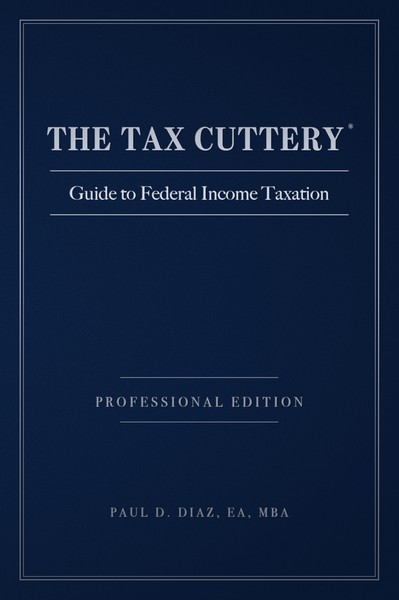
The Book Behind The Practice
Save Smarter.
Prepare Accurately.
Defend Better.
THE TAX CUTTERY® Guide to Federal Income Taxation, Professional Edition. Planning, preparation and resolution: three sections that connect the full arc of your federal tax life. Build the foundation for better questions and more useful professional conversations.
Your digital assets belong in that bigger financial picture. Specific crypto transactions still require their own records and analysis.
The Guide is $299. Its purchase path remains the book checkout. Already Own A Copy? Register It →
Sources & Review
- IRS · Digital Assets: Income, Dispositions And Records ↗
- IRS · Form 1099-DA: Digital Asset Proceeds ↗
- IRS · Enrolled Agents And Representation Rights ↗
- IRS · Revenue Ruling 2023-14: Staking Rewards ↗
- Congress · GENIUS Act, Public Law 119-27 ↗
- Congress · CLARITY Act: Official Actions ↗
- U.S. Senate · September 15, 2026 Procedural Vote ↗
- Circle · USDC Reserve Transparency ↗
- Circle · USDC Terms ↗
- Circle · USDC Risk Factors ↗
- Circle · Native And Bridged USDC ↗
- Circle · CCTP Burn-And-Mint Transfers ↗
- Bitcoin.org · Payments, Confirmations And Security ↗
General federal tax and payment education. Your records and engagement determine the work. Bitcoin and USDC marks identify the payment assets; no issuer sponsorship or endorsement is implied. Bitcoin Symbol Source · USDC Brand Kit